
Character and Citizenship Education (CCE)
CCE develops students to be of good character and to contribute as active citizens
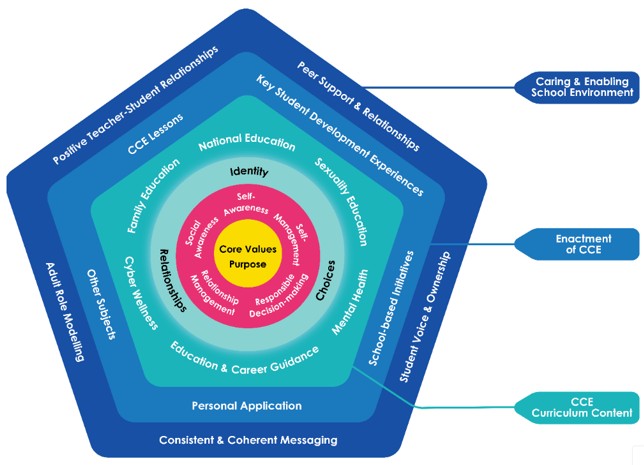
The CCE 2021 curriculum content is premised on the three big ideas of Identity, Relationships and Choices, and anchored on the teaching of core values and social-emotional competencies.
To help students find a sense of purpose, these fundamentals are taught and applied in the following curriculum content areas: Sexuality Education (SEd), Education and Career Guidance (ECG), Cyberwellness (CW), National Education (NE), Family Education (FE) and Mental Health (MH).
Overview
To develop our students’ character, the SGS CCE Department ensures purposeful implementation of the school’s CCE curriculum by aligning our student development experiences and curriculum lessons with our schools’ values, vision and mission. In so doing, we are guided by the principles of student-centricity to customise programmes and curriculum for students of varying developmental needs, interests and profile. To ensure meaningful delivery of the CCE curriculum, we create learning environments that encourage authentic, collaborative and dialogic learning. Ultimately, we seek to engage students to live out their values and citizenship dispositions and embrace the Will to Act.
Our Guiding Principles for CCE Curriculum in SGS
Our Guiding Principles for CCE Curriculum in SGS
Student Centricity | In SGS, we seek to understand our students’ needs, interests, profile and aspirations, to provide them with a range of learning opportunities which aligns with the developmental milestones of the new CCE curriculum. We focus on facilitating student engagement and affording student voice, so as to empower students to derive personal meaning from their contribution to school and the community. |
Intentional Design | We are also guided by the principle of intentional design where careful planning of CCE in and beyond the classroom allow opportunities for students to learn meaningfully. We do not leave learning to chance, as we articulate the intended learning outcomes for our students and provide support for teachers to engage and impact students in their learning. We also regularly take stock of, evaluate, and refine our efforts for CCE. |
Coherent Curriculum | Aside from explicit CCE Lessons and Guidance Periods, our school also enact CCE coherently across the various key Student Development Experiences (SDEs). We also enable students to connect, transfer, and apply learning across different learning experiences, like our school’s ALP and LLP programme. |
Key progressive learning outcomes in CCE
Key progressive learning outcomes in CCE
Secondary 4 Focus: Advocating Change Resilient Learners | In the fourth year, students are informed about the current realities in our National and Global contexts. They examine their inter-relatedness and consider how one can contribute towards being active citizens and make a positive difference at the national or even global level. |
Secondary 3 Focus: Leading by Choice Active Citizens | In the third year, students focus on being more socially aware of others in the community. They learn to recognise, accept and embrace diversity, demonstrate empathy and embrace the Will to Act and contribute to the community. They practise civic consciousness, take moral action and lead in the VIAs carried out within their CCAs. They learn to lead with courage and make responsible decisions. |
Secondary 2 Focus: Building Connections Supporting Peers | In the second year, students focus on building strong connections with their peers. They learn how to manage relationships effectively for the development of personal well-being and learn to support their peers and family. They hone their interpersonal communication skills and demonstrate empathy. |
Secondary 1 Focus: Discovering Self Strengthening Identity | In the first year, students focus on developing a positive self-concept and sense of self-worth, thereby strengthening their self-identity. They learn to adopt a Growth Mindset and develop a positive understanding of self. They also learn to have and awareness of their emotions and learn to manage them healthily. They also learn self-management skills and self-reflection skills, which are key to personal effectiveness and growth. |
Values In Action (VIA)
In alignment with the approach of providing authentic and collaborative learning experiences for SGS students, VIA @SGS adopts the Design Thinking model when planning sustainable VIA projects or activities for the community. These projects are planned and carried out through the school’s CCA programmes. The benchmarks for the projects are aligned to the school’s Learning for Life Programme (LLP), Nurturing Confident and Compassionate Leaders. Below are the outcomes and the process for VIA@ SGS.